Tactile Feedback Systems: Feeling the Road
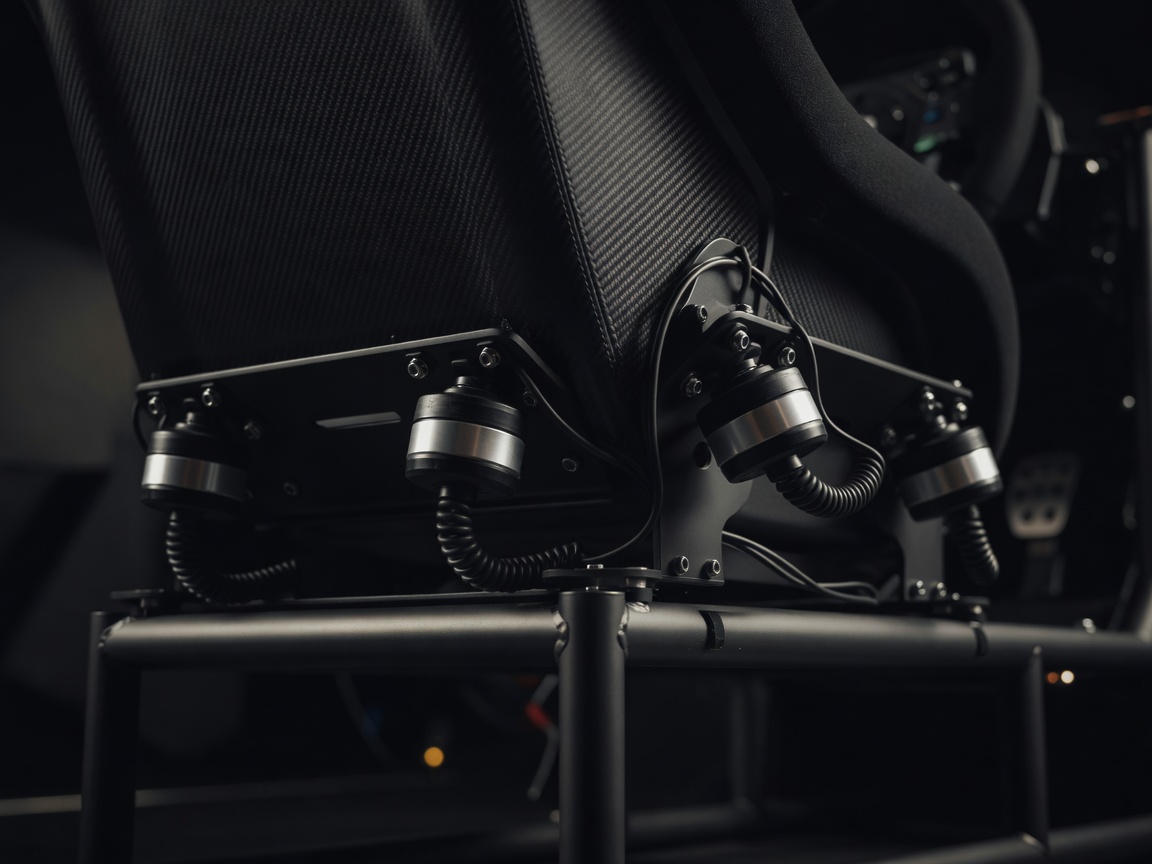
While direct drive wheelbases excel at communicating front tire grip and suspension behavior, the driver in a real car relies on far more than just their hands. In a physical vehicle, the rumble of the engine, the aggressive impact of riding a kerb, and the subtle shudder of the rear tires breaking traction are felt through the chassis and the seat. In a static simulator, this vital sensory data is missing. Tactile feedback systems aim to bridge this sensory gap by introducing physics-driven vibrations into the racing rig.
Bass Shakers and Transducers
The most accessible entry into tactile feedback involves using audio transducers, commonly known as bass shakers. Unlike standard speakers equipped with cones to push air and create sound, transducers consist of heavy magnetic coils designed to bolt directly onto solid surfaces. When an audio signal is passed through them, they vibrate violently, turning the entire simulator chassis into an acoustic resonating chamber.
Telemetry vs. Game Audio
Historically, bass shakers were simply plugged into the subwoofer port of a computer's sound card. While this added a pleasant rumble during explosions or engine revs, it was fundamentally inaccurate for racing. A bass shaker interpreting standard game audio cannot differentiate between the sound of your own engine and the sound of an opponent's car passing by.
Modern tactile systems rely on telemetry-driven software. Simulators broadcast a live stream of telemetry data—wheel slip angles, suspension travel, gear shifts, and RPM limits. Specialized software captures this data and converts it into highly specific frequency signals routed to individual transducers placed around the rig. This ensures that when the left-rear tire locks up under braking, only the transducer mounted to the left-rear corner of your seat pulses.
Strategic Placement for Immersion
For a tactile system to be effective, transducer placement is critical. Sim racers generally deploy multiple shakers to isolate specific effects:
- Under the Seat: The primary location for larger transducers. Used to replicate engine RPM resonance, gear shift impacts, and rear tire slip (traction loss).
- On the Pedal Deck: Smaller transducers placed directly under the brake and throttle plates. Used to communicate front tire lockups (ABS pulsing) and wheel slip during acceleration.
- Four-Corner Configurations: A complex setup where one transducer is assigned to each corner of the aluminum profile chassis, attempting to replicate the independent suspension movements of all four wheels.
Active Belt Tensioners and Motion
Tactile immersion extends beyond vibrations. An emerging trend in the enthusiast market is the active seatbelt tensioner. Driven by the same telemetry data, motorized winches tighten a racing harness against the driver's chest during heavy braking zones, effectively simulating sustained G-forces that static rigs cannot otherwise replicate.
At the pinnacle of immersion sit full motion platforms. Utilizing linear actuators at the corners of the rig, motion systems physically pitch, roll, and heave the entire chassis. While exceptionally expensive, they provide an unparalleled physical link to track elevation changes and sudden weight transfers. However, even with full motion, high-frequency transducers are still heavily utilized to handle the minute road textures that large actuators cannot cycle fast enough to reproduce.
Conclusion
Tactile feedback is often described as the upgrade you never knew you needed until you experience it. Driving a static rig after becoming accustomed to the nuanced vibrations of tire scrub and engine idle feels sterile and lifeless. By leveraging raw telemetry data to drive mechanical vibrations, sim racers can effectively restore the "seat of the pants" feeling, resulting in heightened immersion and more instinctual driving reactions.