Sim Racing Chassis: The Foundation of Rigidity
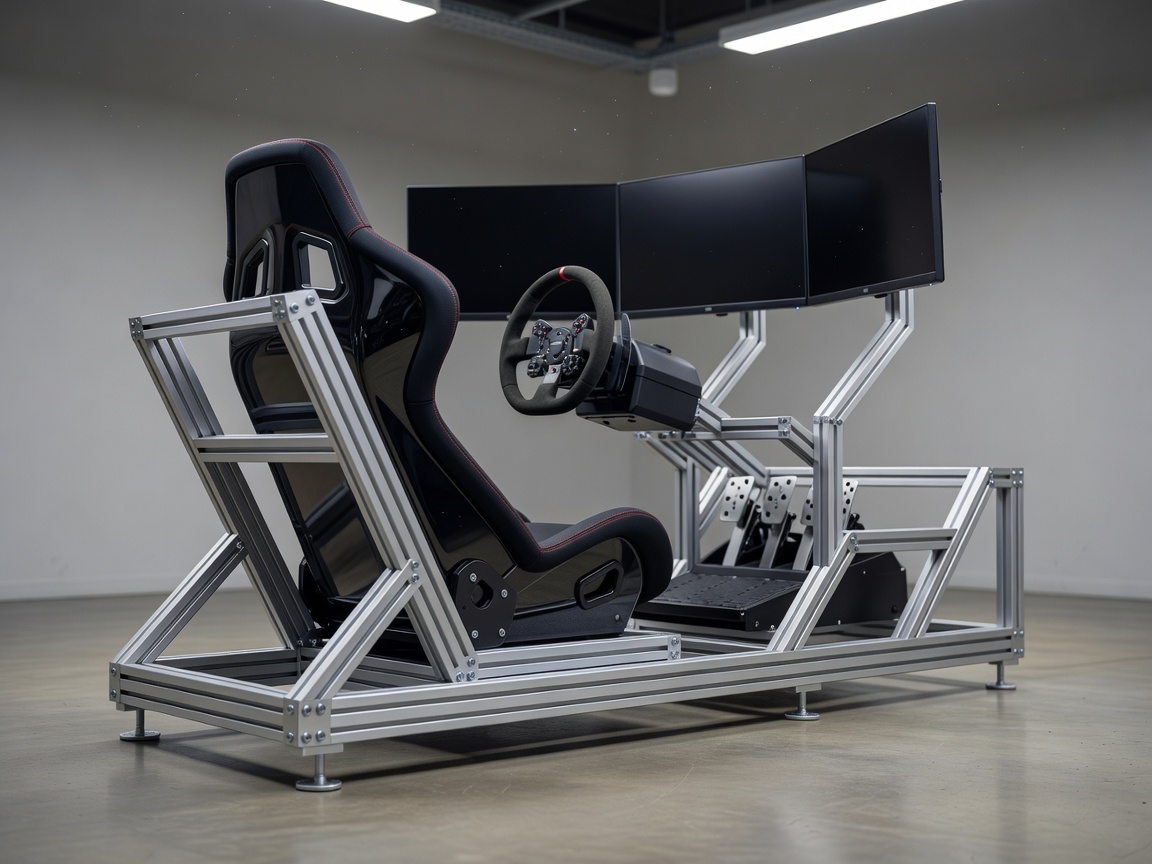
Every piece of high-end sim racing hardware generates significant mechanical forces. A direct drive wheelbase exerts violent, instantaneous rotational torque, while load cell pedals demand severe linear pressure to operate correctly. Without a proper foundation to contain these forces, the energy is wasted in flexing and twisting your mounting solution. This is where a dedicated sim racing chassis becomes indispensable.
The Problem with Desk Mounting
Many sim racers begin by clamping their wheelbase to a desk and placing their pedals on the floor. While perfectly suitable for entry-level gear, this setup introduces three major flaws as equipment scales up:
- Flex: The desk surface will bow under heavy force feedback, absorbing the subtle details of the road texture.
- Movement: Heavy braking pushes the pedal tray away from the driver, or pushes a wheeled office chair backwards, destroying driving consistency.
- Ergonomics: A desk chair and monitor setup rarely mimics the seating posture and steering wheel angle of a real race car, leading to discomfort over long endurance stints.
Tubular Steel Rigs vs. Aluminum Profile
When transitioning to a dedicated chassis, buyers generally face two architectural choices: tubular steel structures or aluminum profile extrusions.
Tubular Steel Designs
Tubular rigs are constructed from pre-bent steel pipes welded into a fixed frame. Their primary advantage is aesthetics; they often look sleek, closely resembling the roll cage structure of an actual race car. However, they suffer from limited modularity. If you wish to change the position of the shifter mount or add a tactile transducer, you are heavily restricted by the pre-drilled holes and welded brackets provided by the manufacturer. Furthermore, thinner tubular frames can still exhibit noticeable flex under extreme loads.
Aluminum Extrusion (8020) Profile
The gold standard for serious simulation is the aluminum profile chassis. These rigs are built using thick rectangular blocks of aluminum featuring T-slots running down their length. Corner brackets and specialized T-nuts are used to bolt the pieces together. The advantages are overwhelming:
| Feature | Benefit for Sim Racers |
|---|---|
| Absolute Rigidity | Zero flex. A properly built 80x40mm or 160x40mm profile rig can withstand the forces of a 25Nm wheelbase without structural compromise. |
| Infinite Modularity | Because T-nuts can slide anywhere along the channel, you can mount accessories, button boxes, and shifters to the exact millimeter of your preference. |
| Future-Proofing | If you upgrade to an entirely new ecosystem (e.g., adding a motion platform or triple monitors), the standard T-slot design allows you to buy supplementary profiles and bolt them directly to your existing rig. |
Seating Positions
A chassis also dictates your posture. Sim racing typically categorizes seating positions into two styles: GT and Formula.
GT Seating: Mirrors a standard sports car or GT3 car. The driver sits relatively upright, with the pedal deck situated below the hips. This is versatile, comfortable for long stints, and easier to climb in and out of.
Formula Seating: Replicates a modern single-seater. The driver is reclined heavily backwards, with the pedal deck elevated so the feet sit level with or higher than the hips. While highly immersive for open-wheel racing, it can be demanding on the neck and lower back without proper lumbar support.
Conclusion
The chassis is arguably the most important, yet least glamorous, component of a simulator. It doesn't generate force feedback or calculate tire models, but it ensures that every dollar spent on high-end hardware translates directly into the physical sensations delivered to the driver. When building a rig, prioritizing structural rigidity via an aluminum profile foundation ensures you will never outgrow your setup, regardless of how advanced your peripherals become.